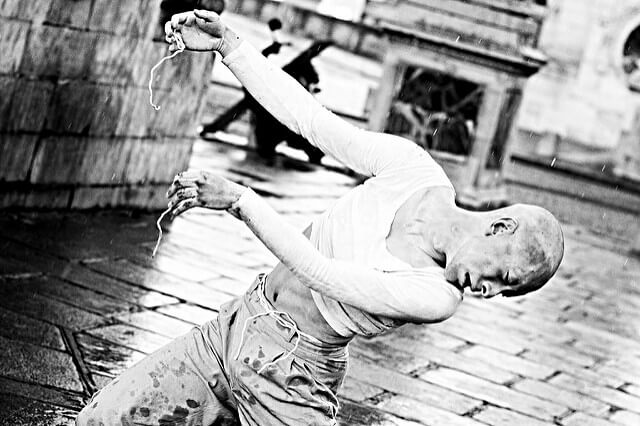
Butoh. Beauty that doesn't have to be pretty.
Butoh is a Japanese 'dance of darkness' that consciously rejects classical beauty. A brief overview of its sources and three recordings worth starting with.
What is it really?
Butoh was born in Japan in the late 1950s. Creators like Tatsumi Hijikata and Kazuo Ohno consciously rejected Western dance aesthetics — upright postures, jumps, lightness, and the spectacularity of movement. Instead, they returned to the earth and the weight of the body.
In Butoh, the center of gravity is low, movement can be extremely slow, and the bodies of the dancers — painted white (shira-nuri) — resemble animated sculptures, ghosts, or figures from a dream. It's not about showcasing agility, but about bringing forth what is hidden, fragile, and imperfect.
3 examples worth starting with
I have chosen three recordings that showcase the range of Butoh — from intimate minimalism to controlled chaos.
1. Kazuo Ohno — emotion in pure form
This is a classic of the genre. In 'Admiring La Argentina', Ohno does not perform complicated figures. He works with mood, hand gestures, and facial expressions. It’s surprising how much can be conveyed with such small movements.
There is something unsettling yet very human about it.
2. Sankai Juku — absolute control
If Ohno represents improvisation and emotion, Sankai Juku embodies precision and discipline. The group is known for its architectural arrangements and work with gravity — just think of performances where dancers slowly descend on ropes.
It’s a visual masterpiece: symmetrical, cool, and hypnotic.
3. Dairakudakan — golden chaos
Finally, something from the other pole. Dairakudakan is spectacle, grotesque, and excess. Their performances — full of golden dust, intense lights, and strange props — balance on the edge of kitsch and ritual.
This is Butoh in its wild, loud, and visually overwhelming version.
Why am I writing about this?
Because it's a good reset for the mind. Butoh reminds us that aesthetics do not end with what is 'pretty' and 'pleasant'. Sometimes, what is rough, slow, and difficult to perceive stays with us longer than a perfect but sterile image.